
by Blaine Greenfield
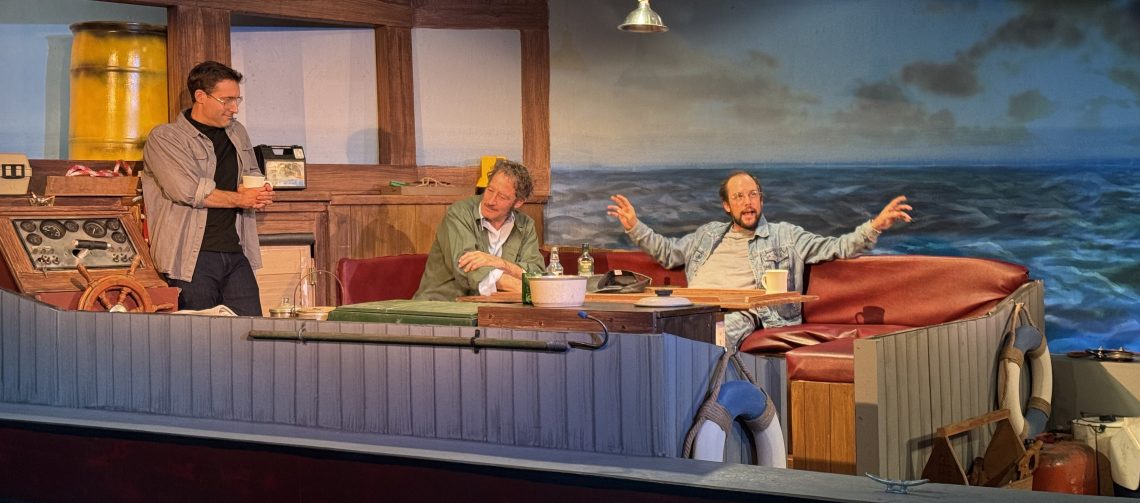
The Shark Is Broken, co-written by Ian Shaw and Joseph Nixon, drops us onto the Orca during the 1974 filming of Jaws, where the notoriously temperamental mechanical shark keeps stalling the shoot. Trapped between takes, Richard Dreyfuss, Robert Shaw and Roy Scheider have nothing to do but talk—and that talk becomes a smart, funny, and surprisingly poignant character study about three men caught between ambition and anxiety, vanity and vulnerability. The comedy bubbles up fast—the barbs are sharp, the timing crisp—and then the play lets the quieter questions surface: What do legacy and craft mean when the ocean—and Hollywood—won’t play along? I liked it very much.
What makes this NC Stage production shine is the talk—outstanding dialogue that sounds tossed off yet lands like truth. The quips have teeth, but the conversations keep circling back to pride, fear, and the grit it takes to keep going when the big fish doesn’t show. You come for the Jaws lore; you stay because the words keep deepening the characters.
Ben Mackel’s Richard Dreyfuss is a marvel. He nails the quick, slightly nasal cadence and the jittery, up-and-coming energy without slipping into caricature; it sounds and feels like Dreyfuss, and it’s lived-in rather than imitated. Richard Neil makes a formidable Robert Shaw—gravelly, magnetic, a poet with a hangover—so when the mask slips, the vulnerability registers. Adam Poole’s Roy Scheider is the ballast: observant, dryly funny, and quietly competitive—the even keel that keeps the Orca steady when the other two start rocking the boat.
Charlie Flynn-McIver directs the production with an assured hand. The pacing breathes; the silences are allowed to do their work; and the trio is given room to spar without ever turning the play into a shouting match. Choices feel actor-centered and story-first, which lets the humor sparkle and the emotion sneak up on you. Scenic designer Julie K. Ross supplies a compact, textured Orca that looks properly scuffed by salt, sun, and ego—practical playing spaces, smart sight lines, and just enough detail to make the deck feel lived-in.
What lingers is how human the piece is. It isn’t a museum tour of a beloved movie; it’s a conversation about professionalism and pride, about how artists carry their demons to work and still find a way to deliver. The jokes are plentiful, the needling is delicious, and then—right when you’re comfortable—the play tips into tenderness and lets you see why these men mattered to each other, and why the film they were making still matters to us.